A Book Annotation Guide for Romance Readers: One Simple Colour Key
On this page
The easiest way to annotate a book is to pick five colours, give each one a single meaning, and write that key on a card you keep inside the book. Use tabs for the pages you want to find again and a highlighter or pencil for the lines themselves. Then, when you finish, copy your favourite lines into one place with the page number, so the annotations are still useful long after the book is back on the shelf.
This guide gives you a ready-made key for romance and romantasy, explains tabs versus highlighters, and shows how to annotate a borrowed book or an ebook without damaging anything.
Why a key matters more than the colours
Annotation goes wrong in one of two ways. Either every page ends up yellow and nothing stands out, or the colours change meaning halfway through the book and you cannot tell later why you marked something. A key fixes both. It limits what you mark, and it makes a pink tab mean the same thing in every book you own.
Keep the key small. Five or six colours is plenty. If you need a seventh, it usually means two of your colours overlap.
A colour key for romance and romantasy
| Colour | What it marks | Mark it when |
|---|---|---|
| Pink | Swoon | A look, a touch or a line between the couple makes you stop |
| Red | Spice | The heat goes up, so you can find the scene again (or skip it on a reread) |
| Blue | Tears | A moment hurts, or you had to put the book down for a minute |
| Yellow | Favourite lines | The sentence is good on its own, out of context |
| Purple | Banter | Something made you laugh out loud |
| Green | World and plot | Magic rules, maps, clues and anything you will need in book two |
Green earns its place in romantasy, where the world can be as important as the couple. In a contemporary romance you might swap it for red flags or character growth. Change any meaning you like, but change it before you start the book, not in the middle.
Write the key on an index card or a bookmark and keep it in the book. A year from now, you will be glad you did.
Tabs, highlighters or both
Tabs and highlighters do different jobs, and most annotators use both.
- Tabs stick out of the page edge, so they help you find a page. Use one tab per page, in the colour of the most important thing on it. They come off again, which makes them the gentlest option.
- Highlighters mark the exact line. They are fast, but they are permanent and can bleed through thin paper. Test one on the last blank page first.
- Pencil is the quiet option: underline, a star in the margin, or a short word like oh no or him!! It can be rubbed out.
- Sticky notes give you room to write a real thought without writing on the page.
A simple combination that works for most readers: pencil underline for the line, a coloured tab on the page edge, and a sticky note only when you have something longer to say.
How to annotate without ruining the book
Annotating is a way of loving a book, but some books are not yours to mark, and some you want to keep clean.
- Borrowed and library books: do not write on the pages. Use a separate notebook and note the page number with each thought. Tabs can lift ink or leave marks on older paper, so skip them too.
- Special editions: use transparent sticky notes and write on those, or pencil only.
- Paperbacks you love to death: go for it. A well-annotated copy is a lovely thing to reread or lend to a friend.
- Thin paper: use gel highlighters or coloured pencils, which bleed less than liquid ink.
Annotating an ebook
Most e-readers and reading apps let you highlight in a few colours and add a note to a highlight. Use the same key as for paper, so your colours mean the same thing whatever you read on. Where the app offers fewer colours than your key, let the note carry the meaning: start it with one word, such as swoon or tears.
Ebook highlights have one weakness: they live inside that app, tied to that book. If you change apps or the book leaves your library, they can be hard to get back. That is one more reason to copy the best ones out.
Keep the annotations findable
An annotated book is a beautiful object. It is also a terrible search engine. When you want that line six months later, you will not remember which book it was in, let alone the page. So when you finish a book, spend five minutes on this:
- Flip through your yellow and pink tabs. These are usually the lines you will want again.
- Copy the best three to ten lines into a quote log. One log for every book, not one per book.
- Add the book, the page and one tag. Use the word from your key, such as swoon, banter or tears, so you can search by feeling later.
- Write one line about why it mattered. Who said it and what it meant, without spoiling the plot.
Our guide to saving book quotes and finding them later goes into the quote log in more detail. Your other colours can feed the rest of your journal: count the red tabs when you give the book a spice score, and the blue ones when you decide how hard it hit. Our guide to spice and tear ratings has a scale you can borrow.
Annotation ideas beyond the colours
- Write the date you started and finished on the inside cover.
- Mark the page where you knew you loved it, and the page where you knew you were in trouble.
- Put a small star next to every trope you spot, then list them at the back. Our guide to tracking tropes explains which ones are worth keeping.
- On a reread, use a different pencil colour, so you can see what you noticed the second time.
How Cherry Books handles it
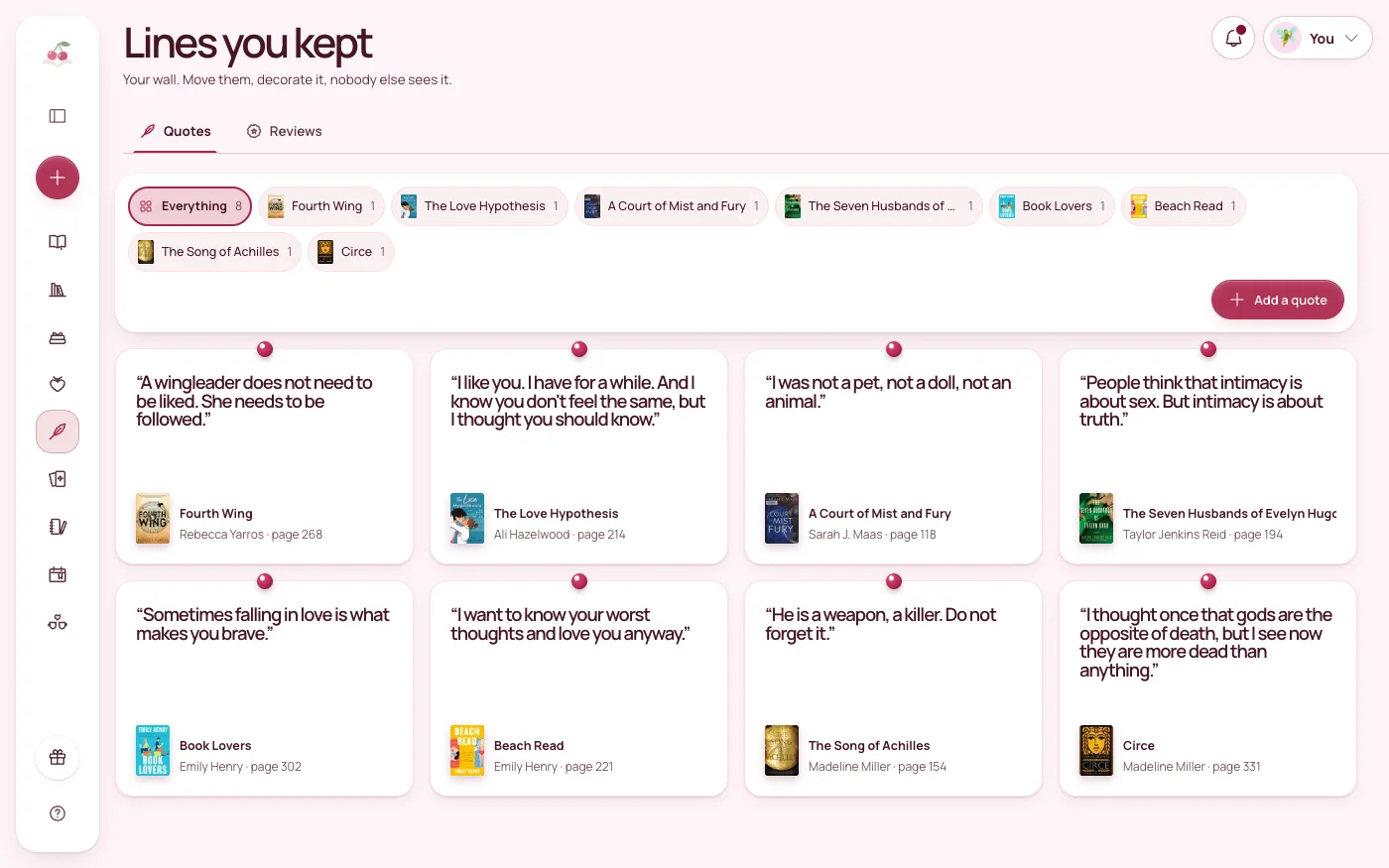
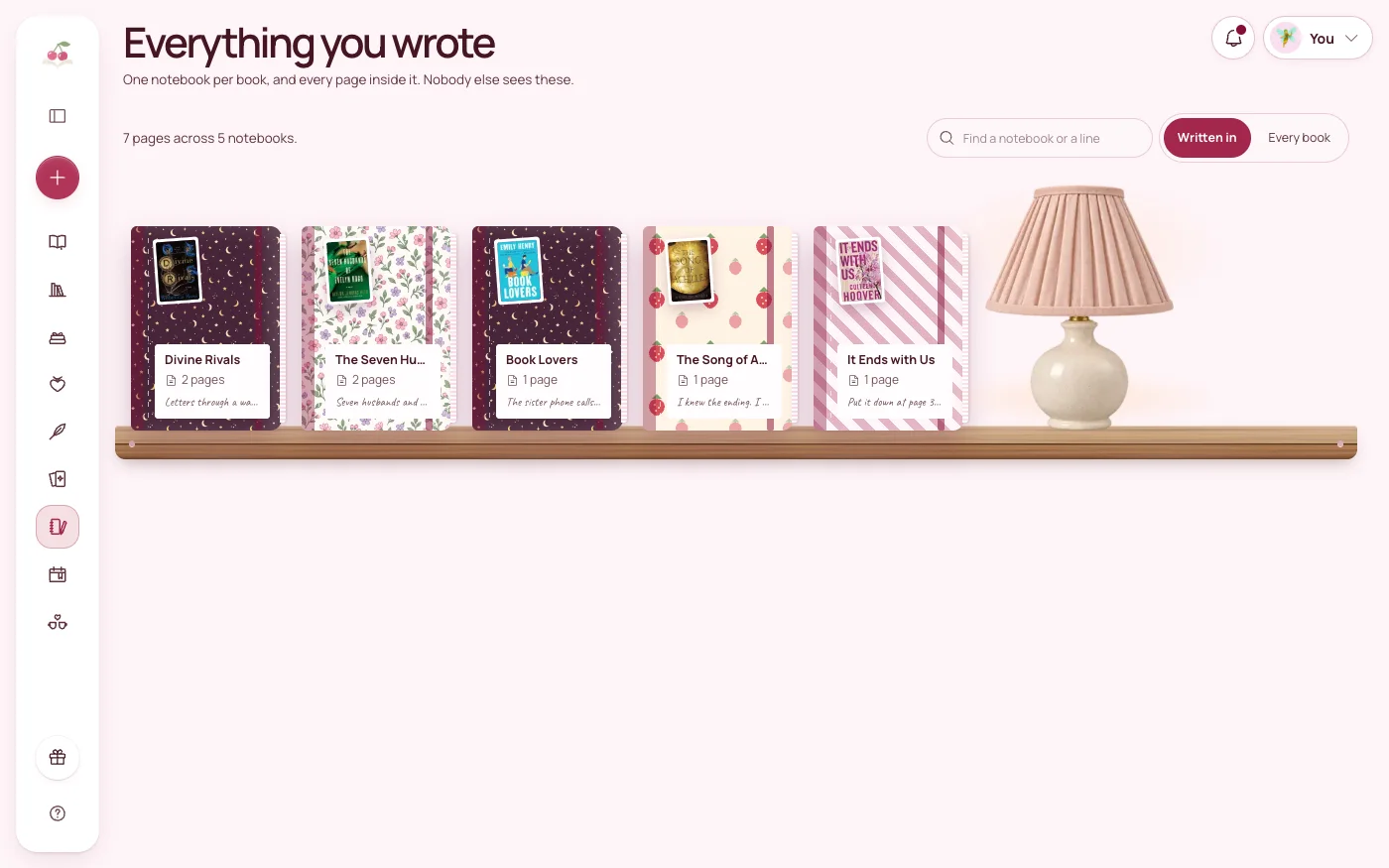
Cherry Books is where the copied-out part lives. Every book has its own notebook for your notes, and the quote wall keeps the lines you saved with their page numbers, so the book and the page are always attached. Next to that, each book has a spice meter, a tear meter and trope tags, so the counts from your tabs have somewhere to go.
It works in the browser on your phone, tablet or laptop, so you can type a line in while the book is still open beside you. Everything you write is private. If you are new to keeping notes on a screen, our guide to a digital reading journal is a good place to start.
The short version
- Choose five or six colours and give each one a single meaning.
- Write the key on a card and keep it in the book.
- Tabs to find the page, pencil or highlighter to mark the line.
- Never mark borrowed books: use a notebook with page numbers.
- Use the same key for ebook highlights.
- When you finish, copy the best lines into one quote log with the page and a tag.
The tabs show you loved the book. The quote log lets you find out why, years later.
Try Cherry Books free for 7 days
Keep your notebooks, quotes, TBR and reading progress together. A payment card is required for the 7-day subscription trial. Cancel before the trial ends to avoid a charge; the monthly plan is $7.99 after the trial.
Keep reading
How to Save Book Quotes and Actually Find Them Later
Save the lines you love with the book, the page and a tag, so you can search your quotes later instead of scrolling a notes app for ten minutes.
21 Reading Journal Ideas That Make Every Book More Memorable
Looking for reading journal ideas? Try 21 simple, creative prompts for book notes, favorite quotes, tropes, monthly wrap-ups, and more.
How to Start a Digital Reading Journal (and Actually Keep Using It)
Learn how to make a digital reading journal you'll enjoy using, with simple layouts, book notes, quotes, and reading reflections.