Spice and Tear Ratings, Explained (and How to Build Your Own Scale)
On this page
Ask three romance readers what a three-flame book is and you will get three different answers. That is the whole problem with spice ratings, and also the reason people love them. A star rating tells you whether a book was good. A spice rating tells you what is inside it, which is often what decides whether you pick it up at all.
This guide explains the vocabulary readers use, the scales you will meet, why tear ratings are the natural companion to heat ratings, and how to build a personal scale that stays consistent over hundreds of books.
First, the vocabulary
Before numbers, most readers sort books by how the love scenes are handled on the page. The terms are informal, and authors and reviewers use them slightly differently, but the broad meaning is shared.
- Closed door (or sweet). Physical intimacy happens off the page. The scene ends at the door, or the chapter simply moves on.
- Fade to black. Intimacy is acknowledged and the scene cuts away at the key moment, then picks up afterwards.
- Open door. The love scenes are written out on the page, usually with some variation in how much detail and how much language.
- Steamy, spicy, smutty. Readers' shorthand for open-door books with frequent or explicit scenes. There is no official line between these words.
These labels describe whether and how a scene appears. A spice rating adds a second dimension: how much, and how explicit. Two open-door books can be very different reads.
Why a separate spice rating beats the star rating
A five-star book is not necessarily a high-heat one, and a spicy book is not necessarily a good one. If you only keep a star rating, the heat information is lost, and so is your ability to answer two practical questions: what should I read when I want something low-heat for a long train ride? and what should I avoid lending to my mother?
Keeping heat as its own field also protects your star ratings from bias. You can give a closed-door book five stars and a high-heat book three, and the numbers stay honest, because the heat is recorded elsewhere.
The usual scales
There is no official standard, but a five-step scale, often shown as flames, chilis or peppers, is the most common shape you will see in reader communities. One to five is easy to remember and fine-grained enough to be useful. Here is one set of definitions that works well as a starting point. It is a suggestion, not a rule, so adjust the wording until it fits your own sense of the genre.
| Level | What it usually means |
|---|---|
| 0 | No on-page romance heat, or none worth rating. Kissing at most. |
| 1 | Closed door. Warm, romantic, and the bedroom door stays shut. |
| 2 | Fade to black. Intimacy is clearly implied, the scene cuts away. |
| 3 | Open door, moderate. A few scenes on the page, written with restraint. |
| 4 | Open door, frequent and detailed. Scenes are a significant part of the story. |
| 5 | Very explicit or very frequent. You will want to know before you read it on your lunch break. |
If you use a scale like this, resist the urge to rate heat relative to the genre. A four should mean a four whether you are reading a dark romance, a cozy fantasy or a contemporary rom-com. Otherwise your numbers stop being comparable.
Tear ratings: the other half of the feeling
Heat tells you what is on the page. A tear rating tells you what the book will do to you. It is the same idea applied to emotion: how likely is this one to make you cry, and how hard?
- 1. A lump in the throat at most.
- 2. One quiet moment that gets you.
- 3. You will tear up at least once, probably near the end.
- 4. Tissues out. More than one scene.
- 5. Ugly crying, and you will need a few days afterwards. The book hangover is real.
Tears are surprisingly useful for planning. A tough, heavy read followed by a four-tear book is a bad week; following it with a one-tear comfort re-read is how you recover. It also becomes a lovely number to look back on when you build your year-in-books recap.
Spice is not the same as content warnings
A heat rating tells you how explicit love scenes are. It does not tell you about difficult themes such as grief, abuse, violence, infidelity or other topics that some readers need to avoid. Keep these separate. A book can be a one on the spice scale and still contain material a reader needs advance notice of, and an explicit, very high-spice romance can be entirely gentle in what it depicts. If you track warnings for yourself, give them their own tags rather than folding them into a number.
Build your own scale in five steps
- Pick a range. Zero to five is a good default. Fewer levels make you hesitate less; more levels make you inconsistent.
- Write one sentence per level. Use the table above as a template and keep your definitions where you will see them, such as the first page of your journal or a pinned note.
- Anchor each level with a book you know. Choose a title for every step. When you are unsure about a new book, compare it with your anchors rather than guessing in the abstract.
- Rate straight after finishing. Heat and tears are fuzzy in memory. Do it the same evening, when the book is fresh.
- Review once a year. If you notice your fives creeping up or your definitions drifting, re-anchor. Consistency matters more than perfection.
What to do with the numbers
The payoff comes from filtering. With a spice and tear rating on every book, you can ask your shelf concrete questions: show me everything I rated three flames or higher that also made me cry, or show me the low-heat books I have not read yet for the next trip. If you also tag tropes, you can combine them, and your own taste starts to show up in the data. We cover the whole logging approach in how to track your reading as a romance reader.
How we handle it in Cherry Books
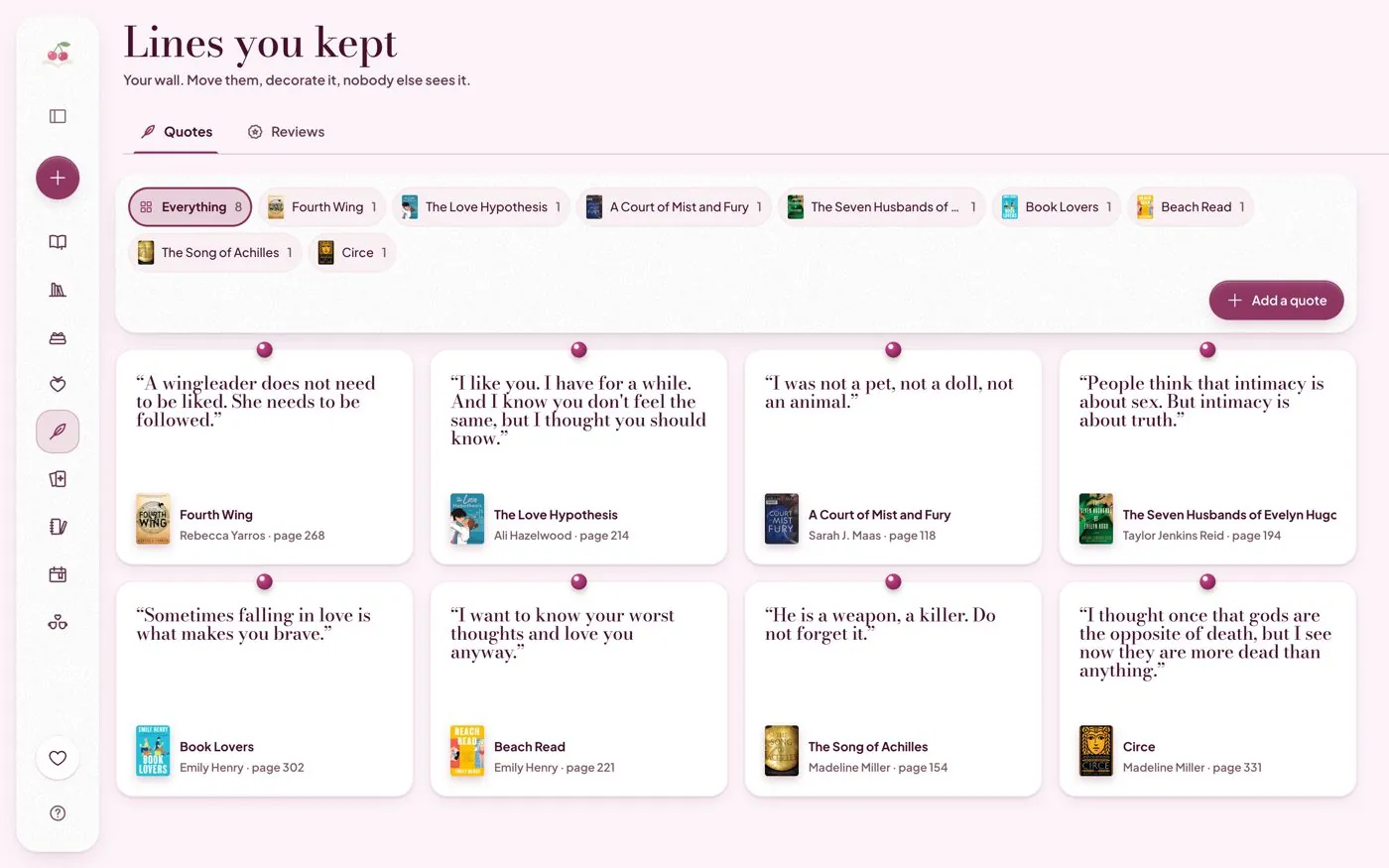
In Cherry Books, every book has a spice meter of up to five flames and a tear meter of up to five drops, set separately from the star rating, which allows half stars. In the library you can filter for books with at least a given spice level and for the ones that made you cry, and spice shows up on the cards you can make from your shelf. It can also read a spice column from a spreadsheet or file when you bring your books over. There is a 7-day free trial if you would like to try the meters on a few of your own books.
Whatever tool you use, the habit is the same: decide what the numbers mean, write it down once, and let your future self find the next book that is exactly as spicy, and exactly as heartbreaking, as the evening requires.
Try Cherry Books free for 7 days
A reading tracker for romance readers: spice and tear meters, tropes, quotes, series, buddy reads and a year recap. Cancel before day 7 and nothing is charged, then it is from $4.99 a month.
Keep reading
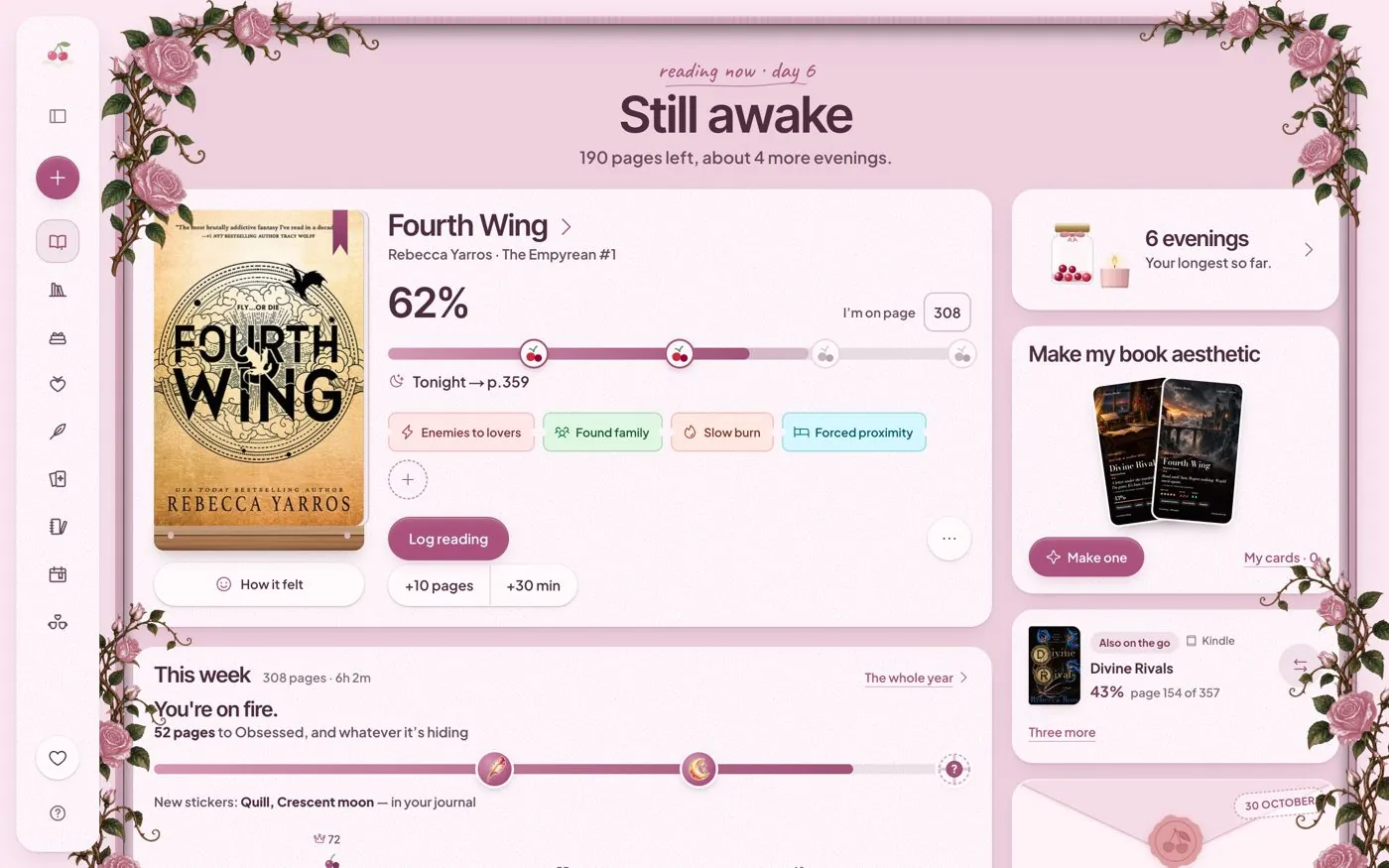
How to Track Your Reading as a Romance Reader
What a reading tracker for romance books should record beyond stars: spice, tears, tropes, series order and kept lines. A practical setup guide.
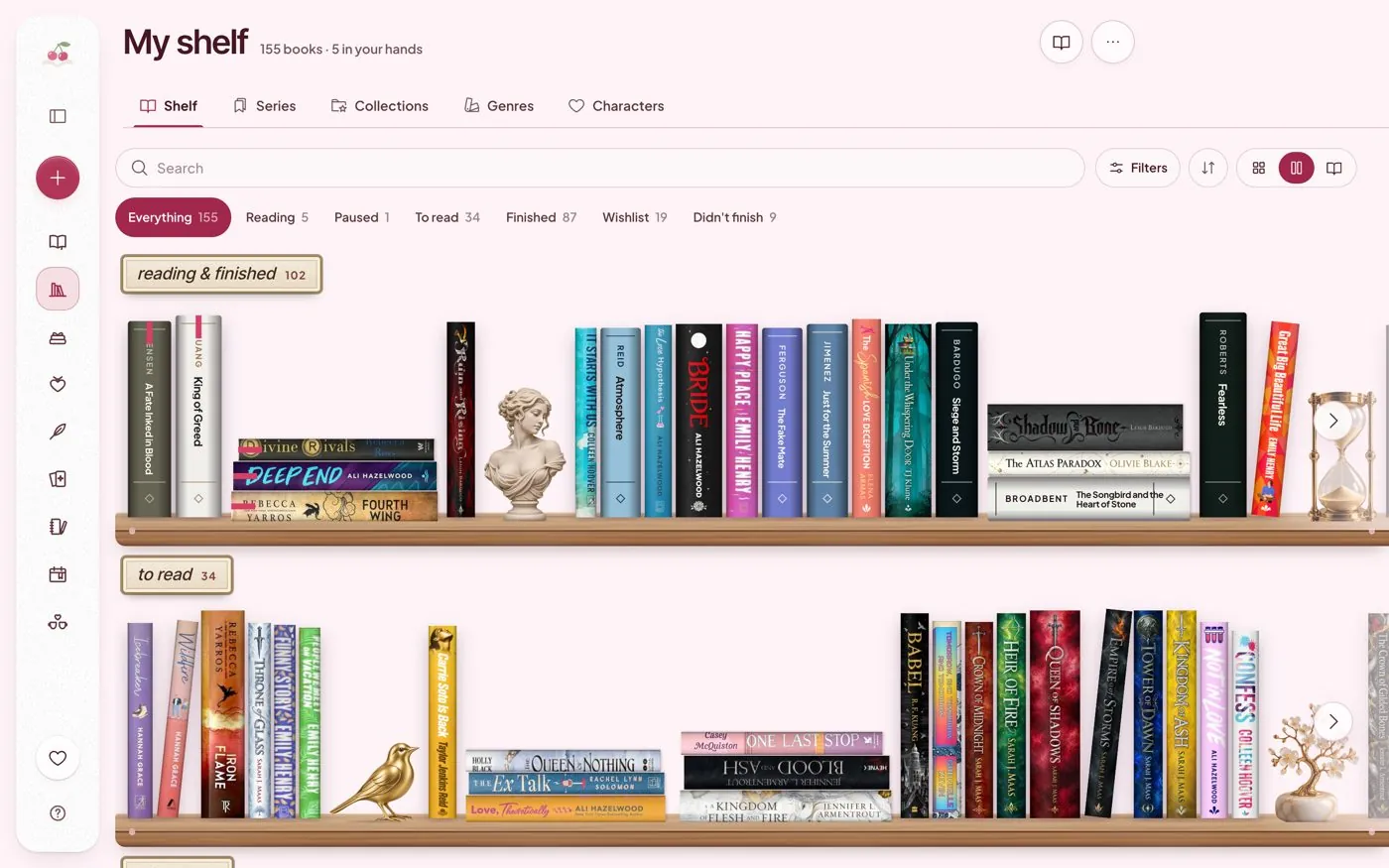
Best Book Tracker Apps Compared: Goodreads, StoryGraph, Fable and Cherry Books
An even-handed look at Goodreads, StoryGraph, Fable and Cherry Books as book tracker apps: real pros and cons, and how to choose for your reading style.
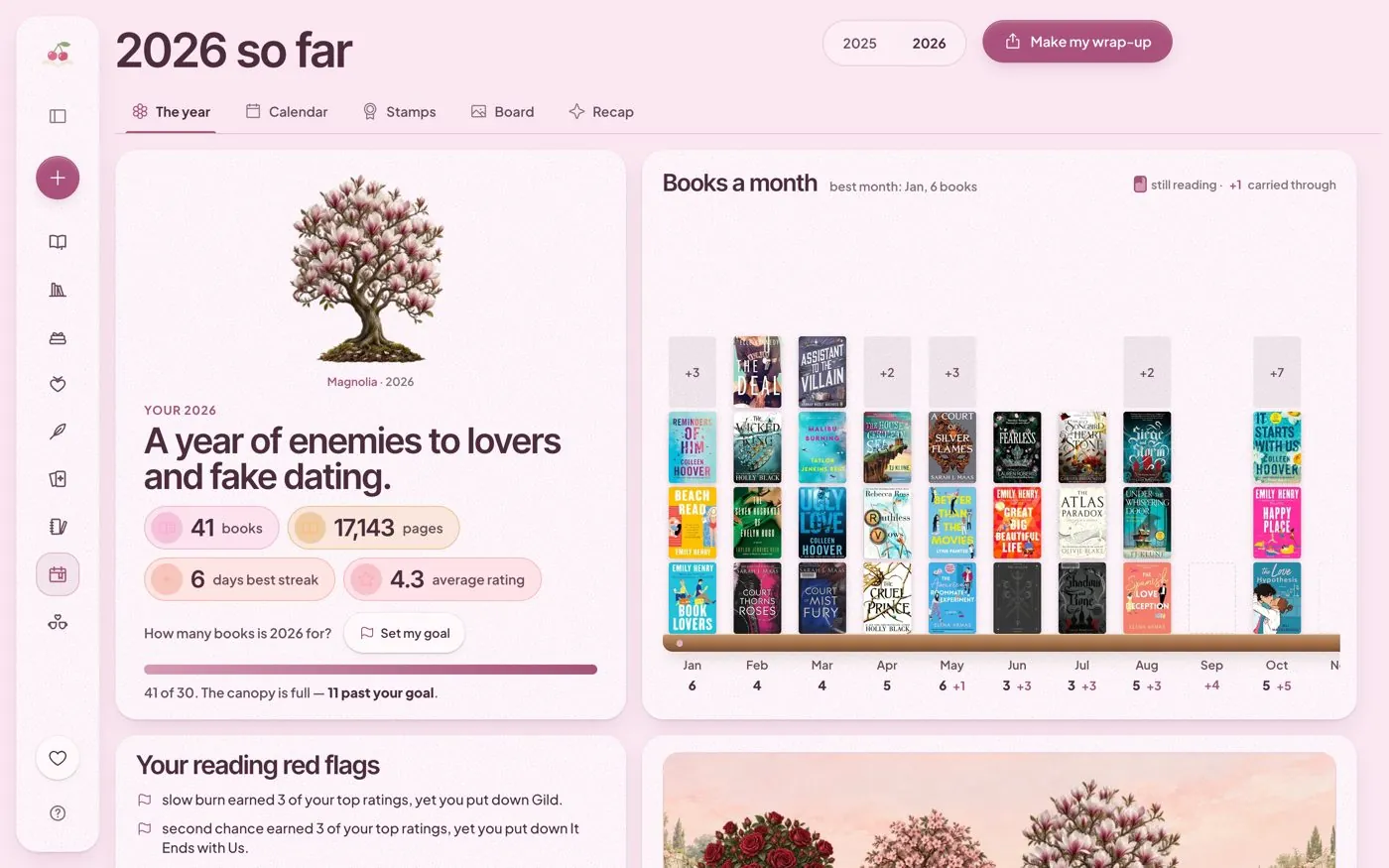
How to Wrap Up Your Reading Year: A Year-in-Books Recap Guide
What to count, how to collect it and how to share it: a practical guide to a year-in-books reading recap, with stats worth tracking and prompts.