How to Track Your Reading as a Romance Reader
On this page
Most reading trackers were designed around one question: how many books did you finish? That is a fine question, and it is the least interesting thing about a romance reader's year. You do not remember a book by its page count. You remember that the hero was a golden retriever, that the second act wrecked you, that the library copy fell open at the page you reread four times.
A good reading tracker for romance books keeps the part you will want back in six months. This guide is a practical way to set one up, whether you use a spreadsheet, a paper notebook or an app. Nothing here needs special software; the point is deciding what is worth writing down.
Log five things for every book
The temptation with any tracker is to record everything and then abandon it by February. Five fields are enough, and each one answers a question you will actually ask later.
- Status and dates. Want to read, reading now, finished, paused, or put down. Add the day you started and the day you finished. Dates are what make a year-end recap possible, and they are impossible to reconstruct from memory.
- A rating. Use whatever scale you trust. If a whole star feels too blunt, allow halves. Decide once what each number means for you and stick to it; a five should mean the same thing in March and in October.
- Heat. Romance readers are the one group of readers who routinely need to know how explicit a book is, either to seek it out or to avoid it. A dedicated spice rating beats trying to infer it from a star rating. More on this in our guide to spice and tear rating systems.
- How it made you feel. A tear rating, a one-line verdict, a mood word. This is the field that turns a list into a memory.
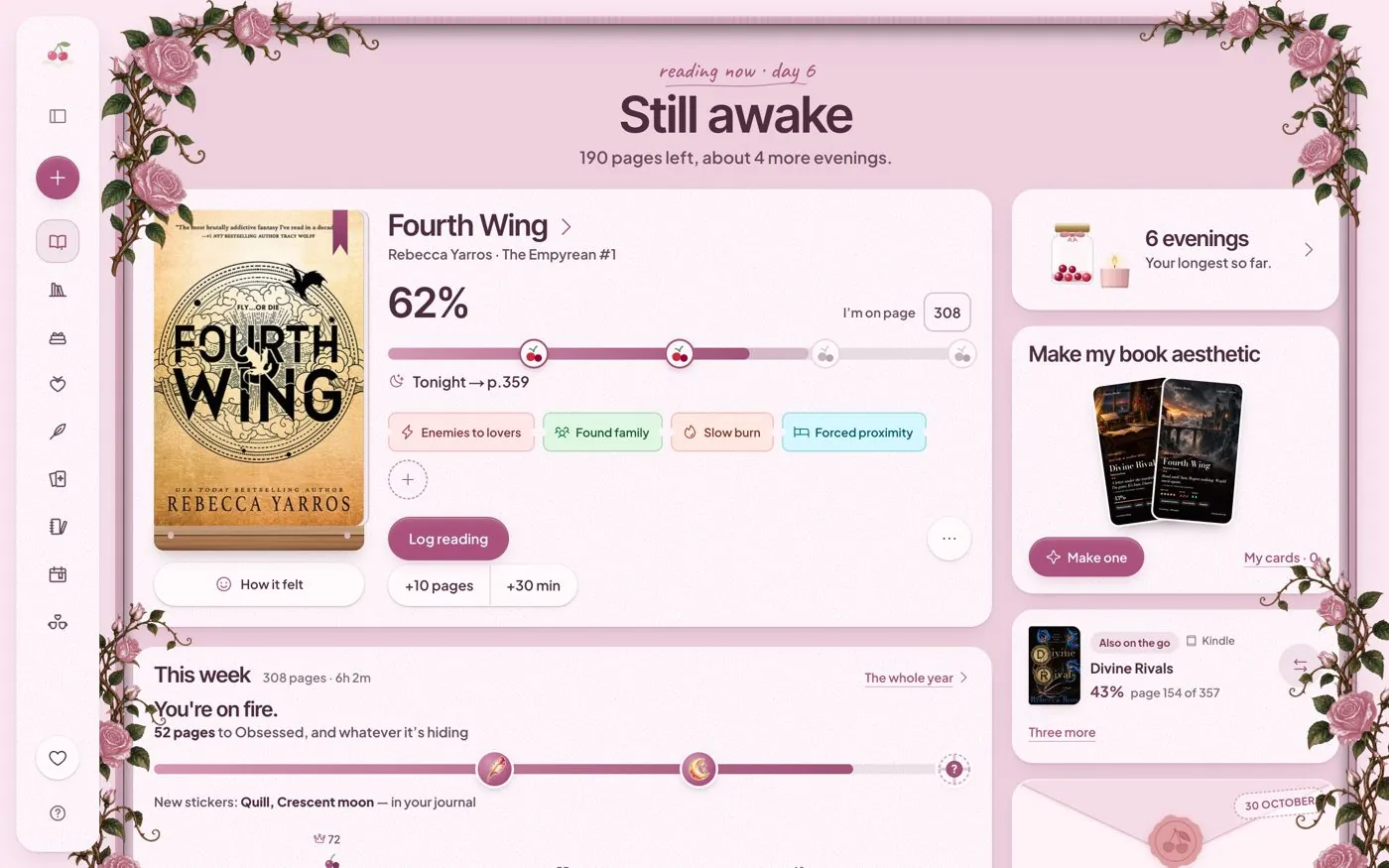
- Tropes. Enemies to lovers, grumpy and sunshine, forced proximity, found family, second chance. Tag them and you can later answer the question every reader eventually asks: what do I actually like?
If you only add one field to whatever you use today, make it the trope tags. They are the most useful data a romance reader can collect, because they explain your ratings. After twenty or thirty books you will see that your five-star reads cluster around two or three tropes, and your abandoned ones around a different two.
Track the reading, not just the finishing
Marking a book as finished is a single event. Reading is the thing that happens over days. Logging even a little of it changes how the whole year looks: pages per evening, the nights you read until two in the morning, the week you did not read at all.
You do not need to log every session. A rough rule that works for a lot of people: update your page number when you put the book down for the night, or tap a timer when you start and stop when you close the cover. A streak counter turns out to be a gentle motivator for people who like that kind of thing, and easy to ignore for people who do not. Audiobooks are worth counting too, in minutes rather than pages, so that the commute chapters do not disappear from your year.
Keep series in order, with the gaps showing
Romance is a series genre. Interconnected standalones, rotating couples, a slow-burn arc that stretches across five books, a spin-off set in the same town. Tracking by single titles loses the thing you most need to know, which is: where did I stop, and what is next?
- Record the series name and the number in the series for every book, even when the books can be read alone.
- When you finish a book, note whether the next one is out yet. If it is not, a waiting shelf stops you from rebuying the same sample.
- Keep the reading order separate from the publication order when they differ. Authors reorder, prequels arrive late, and novellas hide between numbered books.
Keep the lines you read twice
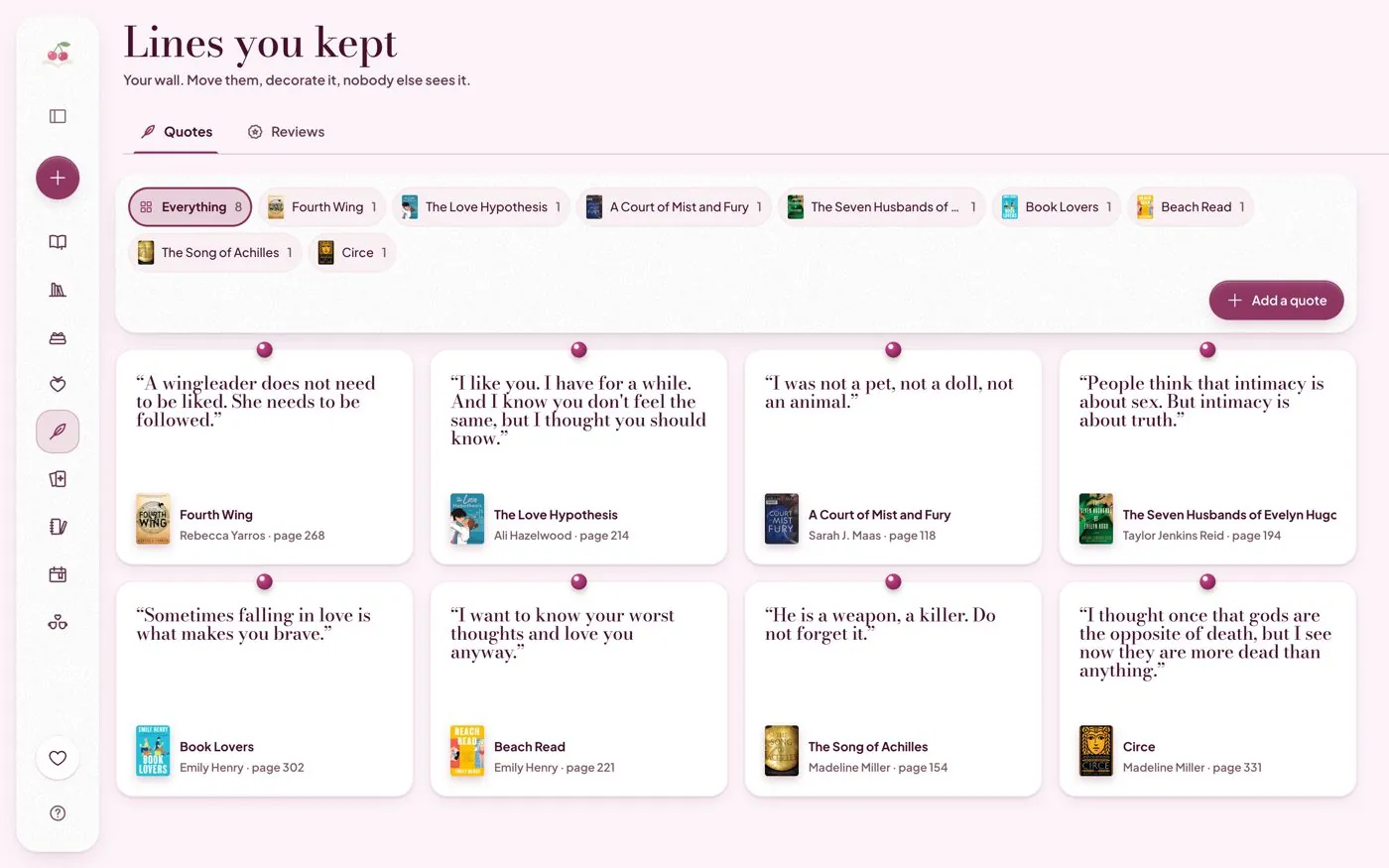
Every romance reader has a pile of half-typed quotes in a notes app. They are worth far more with a page number and a book attached, because three months later you will want to find that exact scene and you will not remember the title. Make it a habit: one line, the page, the book, written the same night. If you want to turn them into posts later, you will already have the raw material, and we cover that in how to make bookstagram posts fast.
A ten-minute setup
If you are starting fresh, or moving from another tracker, this is a sensible order of operations.
- Bring your existing history over rather than retyping it. If it lives on Goodreads, our step-by-step export guide takes about five minutes.
- Decide your scales for rating, spice and tears, and write the definitions on the first page of a notebook or in a pinned note.
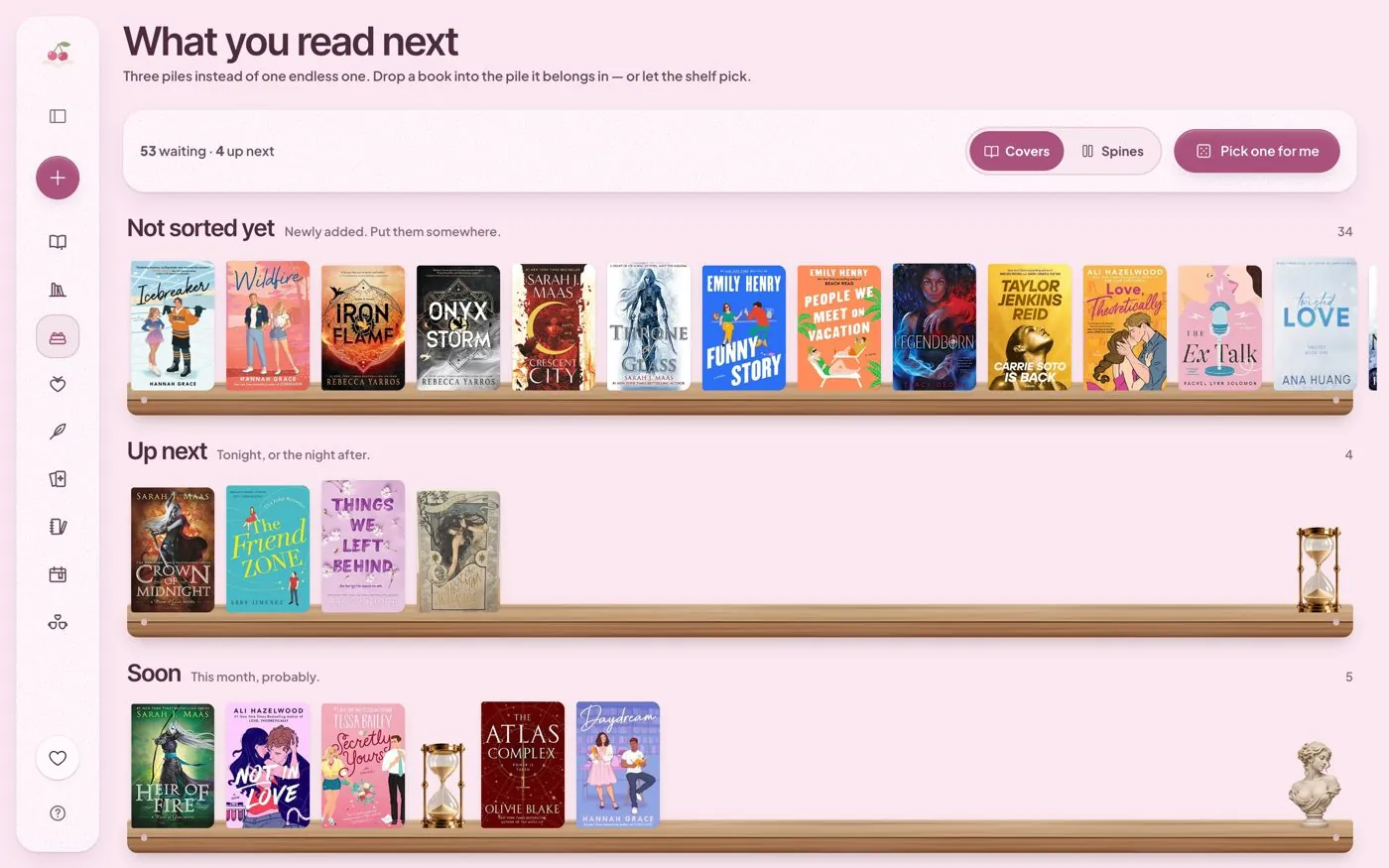
- Create the shelves you will actually use: reading now, finished, want to read, and maybe a waiting-for-the-next-book shelf for series.
- Add the three books you are most excited about to a short up-next list. Your full TBR can wait; see how to manage a TBR that has gotten out of hand.
- Log tonight's page. That is the whole habit.
Spreadsheet, notebook or app?
All three work, and the best tracker is the one you will open at 11 pm with a book in your other hand. A spreadsheet gives you full control and easy formulas, but it is unpleasant on a phone and has no concept of a cover. A paper journal is lovely, tactile and private, and hard to search or total up. An app does the arithmetic for you and keeps everything searchable, at the cost of someone else's design decisions. If you are weighing the options, we compared the popular choices as fairly as we could in best book tracker apps compared.
Where Cherry Books fits
We built Cherry Books because this was the gap we kept running into. Every book carries a spice meter and a tear meter, tropes can be tagged and later filtered, there is a quote wall that stores the page number with each line, series are shown in reading order with the missing numbers visible, and there is a timer, a calendar and a streak for the reading itself. It is a paid app, with a 7-day free trial so you can find out whether the habit sticks, and you can export your whole library in one file at any time.
Whichever tool you choose, the principle holds. Write down the things that make a book yours, keep it light enough to maintain on a tired night, and let the totals take care of themselves.
Try Cherry Books free for 7 days
A reading tracker for romance readers: spice and tear meters, tropes, quotes, series, buddy reads and a year recap. Cancel before day 7 and nothing is charged, then it is from $4.99 a month.
Keep reading
Spice and Tear Ratings, Explained (and How to Build Your Own Scale)
Closed door, open door, one flame or five? How spice ratings and tear ratings work for romance readers, and how to build a scale you can use consistently.
How to Manage a TBR That Has Gotten Out of Hand
A calm method for taming a huge to-be-read list: three piles, a short up-next shelf, a wish list with a basket and a random pick for undecided nights.
36 Reading Journal Prompts for Romance Readers (and How to Keep One)
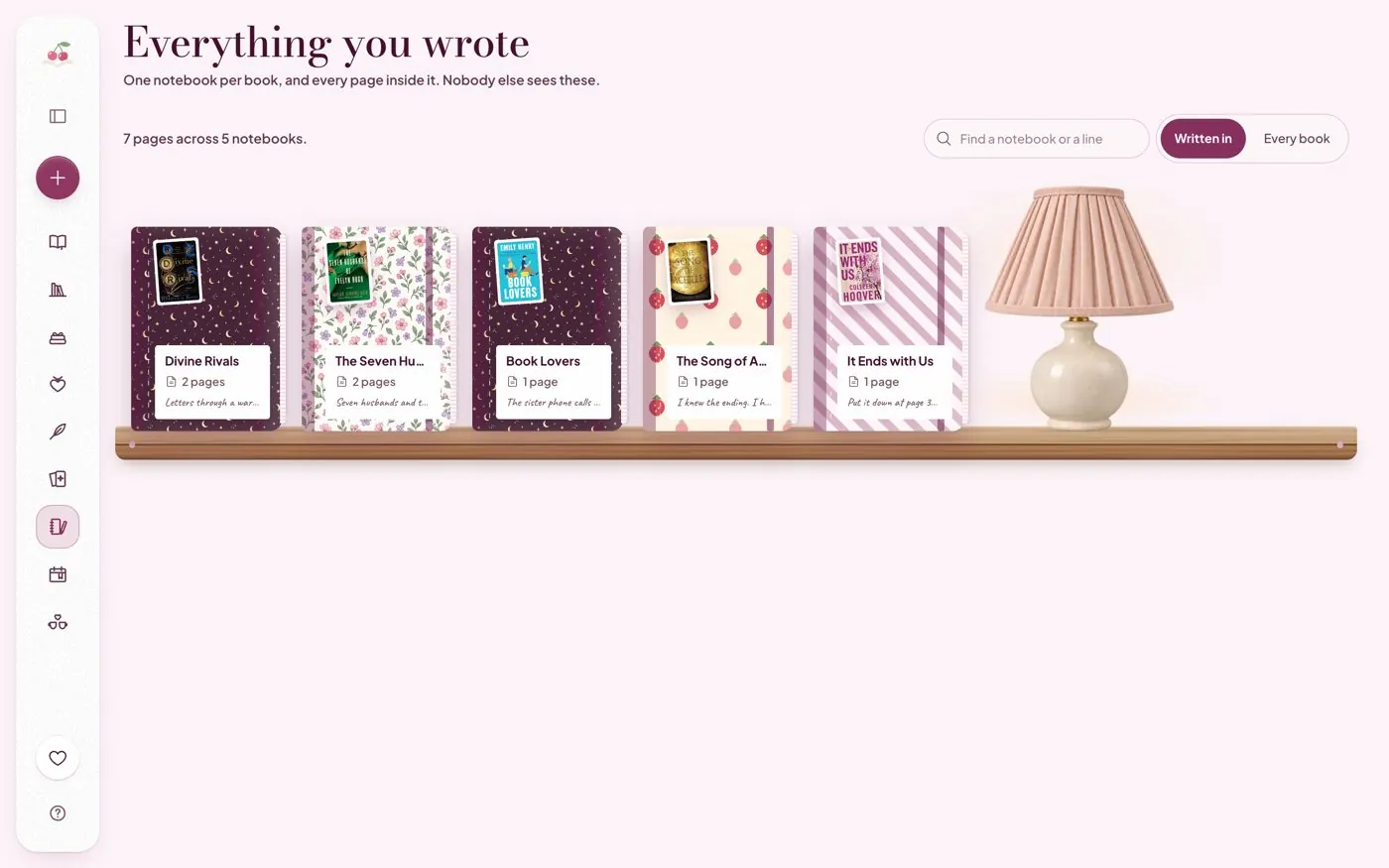
Reading journal prompts for before, during and after a romance, plus a simple way to keep a journal on paper or in an app without it feeling like homework.