How to Set a Reading Goal You Will Actually Keep
On this page
Every January the same thing happens. Somebody announces a goal of one hundred books, reads brilliantly for six weeks, falls behind in March and quietly stops looking at the counter by summer. The goal was never the problem. The number was picked from enthusiasm instead of from how the person actually reads.
A reading goal should make you want to open a book, not make you feel behind on one. Here is a way to set one that survives a busy autumn, a slump and a thousand-page fantasy.
Start from last year, not from a wish
The most useful number you can have is how many books you finished in the last twelve months. If you do not know it, count your shelf or check your reading tracker. Then adjust it by what will be different this year.
- Finished 18 last year? A goal of 20 is a gentle stretch. A goal of 50 is a fantasy.
- New job, new baby or exams? Aim lower than last year and be glad of any book.
- Reading mostly audiobooks this year? They count. Decide that on day one.
- Lots of long series? Count the series as a project, not as ten separate wins.
Choose what counts before you start
Arguments with yourself in December are avoidable. Decide in advance whether novellas, rereads, graphic novels, audiobooks and DNFs count. There is no correct answer, only the one that keeps the goal fun. A common rule is that anything you finished counts once, and a book you stopped at 20 percent does not.
Turn the year into a pace you can feel
Twenty-four books a year is two a month. That sounds smaller and more doable than the year-sized number, and it gives you a monthly checkpoint instead of one huge deadline. Another way is to think in evenings: if a typical book takes you six evenings, how many evenings a week do you read? That tells you more than any slogan.
Track it lightly
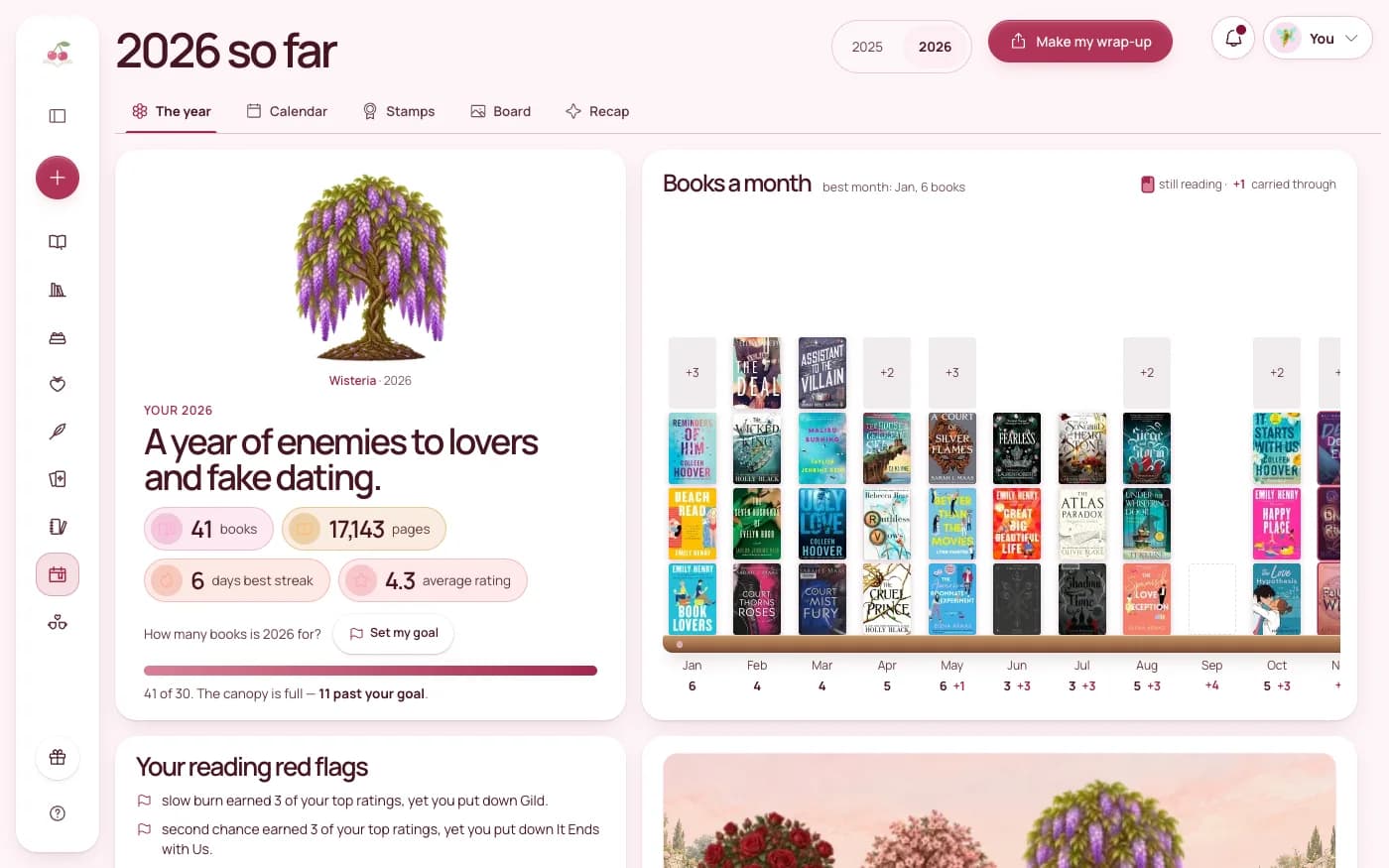
A goal that takes ten minutes of bookkeeping to update will be abandoned. Log a book when you finish it, with a date and a star rating, and that is all. The rest, such as your busiest month, your average rating and your favourite genre, you can read off at the end of the year. If you like seeing it in the shape of a year, our year in books guide shows what a recap can include.
Plan for slumps and busy months
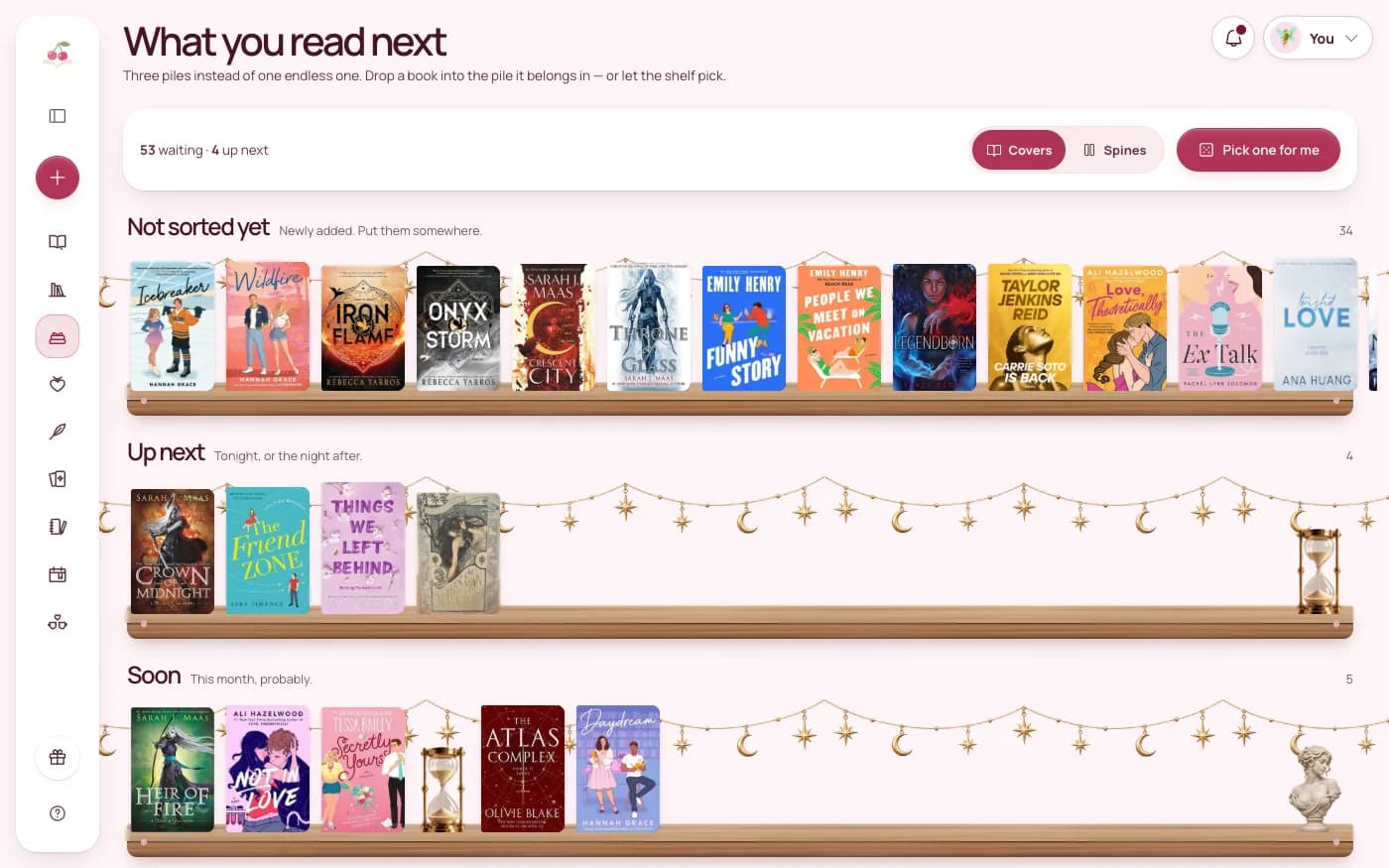
Every reader has a slump. The sensible response is to have a few books you can finish in a weekend ready for it: a short romance, a novella, a book you have read before. A tiny win restarts the habit faster than forcing a big book. Keep two or three of these in your Up next pile, as described in how to manage a TBR that has gotten out of hand.
Check in at the halfway point
On 1 July, look at where you are. If you are well ahead, raise the goal or enjoy the cushion. If you are behind, lower it without guilt. Adjusting a goal is not failing it. It is reading a map you made in January and noticing the road has changed.
How Cherry Books handles it
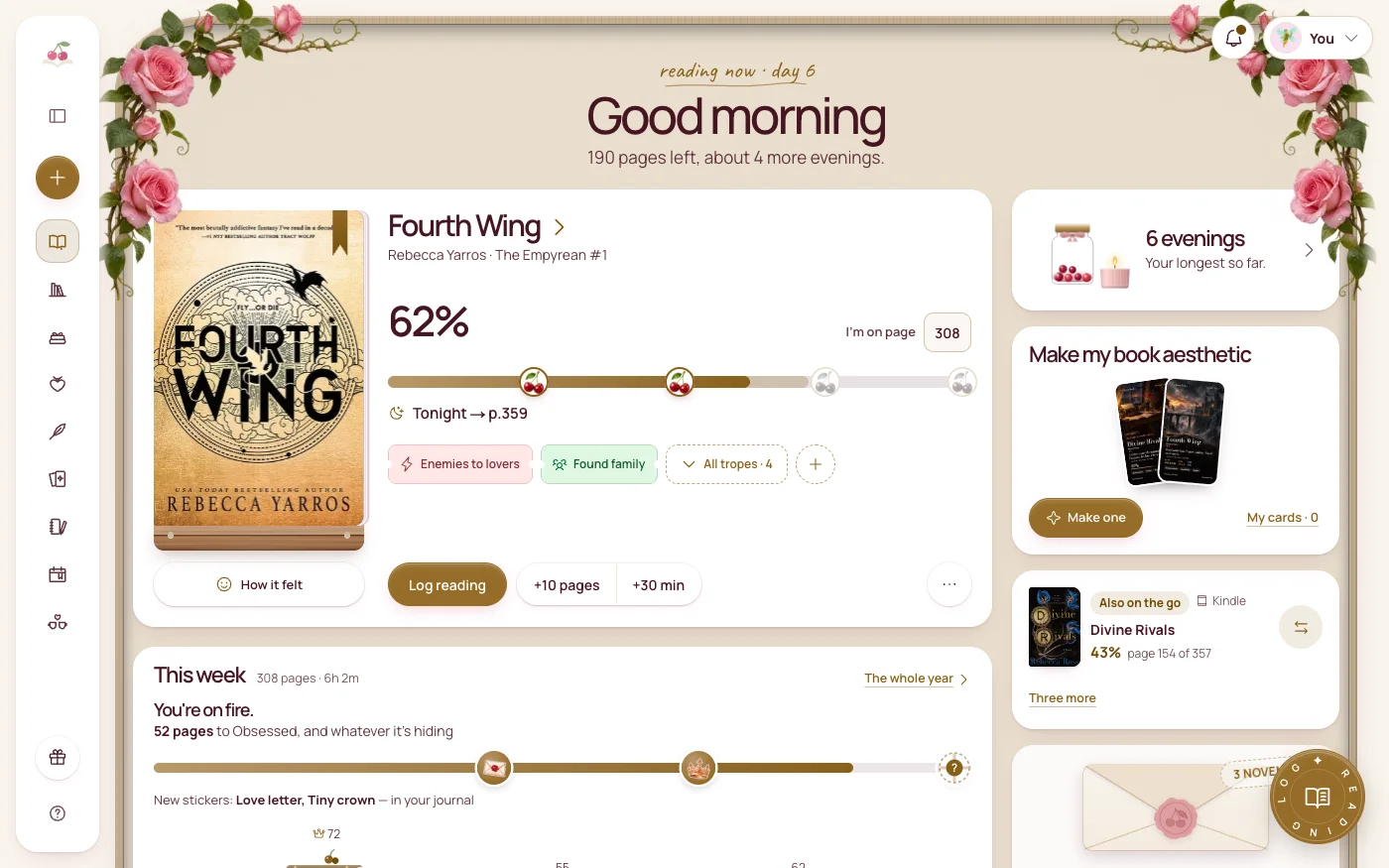
In Cherry Books, you set a yearly goal and watch a tree grow with every book you finish. It shows how many books you have read out of your goal and, at your current pace, roughly which month the tree will fill. There is a streak counter for the days you read and a Reading now screen with your percentage and how many evenings are left at your pace. You can change the goal whenever you like, and the year-end recap draws on the same shelf.
The short version
- Start from how many books you finished last year.
- Decide what counts before January ends.
- Think in books a month, not books a year.
- Log a book only when you finish it.
- Keep a few short, easy books for slumps.
- Review the goal on 1 July and change it if life did.
A good goal is one you are a little proud of and never dread. If yours feels heavy, it is the wrong size, not the wrong reader.
Try Cherry Books free for 7 days
Keep your notebooks, quotes, TBR and reading progress together. A payment card is required for the 7-day subscription trial. Cancel before the trial ends to avoid a charge; the monthly plan is $7.99 after the trial.
Keep reading
How to Wrap Up Your Reading Year: A Year-in-Books Recap Guide
What to count, how to collect it and how to share it: a practical guide to a year-in-books reading recap, with stats worth tracking and prompts.
How to Manage a TBR That Has Gotten Out of Hand
A calm method for taming a huge to-be-read list: three piles, a short up-next shelf, a wish list with a basket and a random pick for undecided nights.
How to Track Your Reading as a Romance Reader
What a reading tracker for romance books should record beyond stars: spice, tears, tropes, series order and kept lines. A practical setup guide.