How to Keep Track of Characters in a Big Fantasy Romance Series
On this page
Book three of a romantasy series opens with a council scene, and eleven people you have not thought about in a year are suddenly in the room. Two of them have similar names. One of them was dead, or was she? You do not want to reread two books, and you do not want to google the plot and meet a spoiler.
Big fantasy romances are wonderful and hard to hold in your head, especially when you read them months apart. A small character tracker solves this, and it takes less effort than you think.
Decide what a character entry needs
You are not writing a wiki. You are leaving yourself a note that will make sense in a year. For each character, three or four lines are plenty.
- Name and how it is spelled. Fantasy names are easy to mix up. Write it once, correctly.
- Who they are to the main characters. Rival, sister, mentor, ex, enemy who is slowly not an enemy.
- Their world. House, court, faction, magic or power, so you can place them.
- One thing to remember. The moment that defines them: saved the heroine at the border, lied about the letter.
Write notes without spoilers for later
A tracker is only safe if it respects where you are in the series. Write each note as of the book you are reading, and mark which book it came from. That way, when you return to book two a year later, you can read your notes up to there and not a line beyond. If you are sharing the reading with a friend, the same rule keeps you both safe; see how to run a buddy read without spoilers.
Add characters as they matter, not all at once
The temptation is to catalogue everyone in chapter one. Do not. Add a character the second time they appear, or when you realise you would be lost without them. It keeps the list short and the entries meaningful, and the people who never come back never clutter it.
Keep relationships, not only names
The thing most easily forgotten in a long series is who stands where. Who is loyal to whom, who owes a debt, who is secretly in love with whom. A one-line relationship note on each side of a pair is more valuable than a paragraph of description. It is also the part you will enjoy reading back at the start of the next book.
Pair it with your series notes
Characters are most useful next to the order of the books and where you stopped. Together they answer the three questions you have when you pick a series back up: what is next, where was I, and who is that again? Our guide to keeping track of book series order covers the other half.
Make it part of your recap
When you finish a book, spend two minutes updating the entries for the people who changed. Someone died, someone switched sides, someone fell in love. Those two minutes are the reason you will be able to start the next book on the first night, with no rereading. A character list also makes a lovely way to remember a story: a gallery of the people you spent the week with.
How Cherry Books handles it
In Cherry Books, each book can keep its own characters, each with a character passport for the details you want to remember. Series are tracked separately, so you can see which number you are on and where you stopped. Because the characters live with the book's own notebook, your notes are there when you open the book and never need a separate document. The tropes you tag, such as enemies to lovers or found family, sit next to them, which makes it easy to spot why you love a particular pairing.
The short version
- Give each character a name, a role, a world and one memorable moment.
- Write each note as of the book you are in.
- Add characters when they matter, not on page one.
- Note relationships as well as names.
- Update the entries when a book ends.
A character tracker does not take away the surprise of a series. It lets you walk into book four already knowing who is in the room.
Try Cherry Books free for 7 days
Keep your notebooks, quotes, TBR and reading progress together. A payment card is required for the 7-day subscription trial. Cancel before the trial ends to avoid a charge; the monthly plan is $7.99 after the trial.
Keep reading
How to Keep Track of Book Series and Reading Order Without Losing Your Place
Publication or chronological order? A simple system to track which book in a series you read, what is next, and where novellas and spin-offs fit.
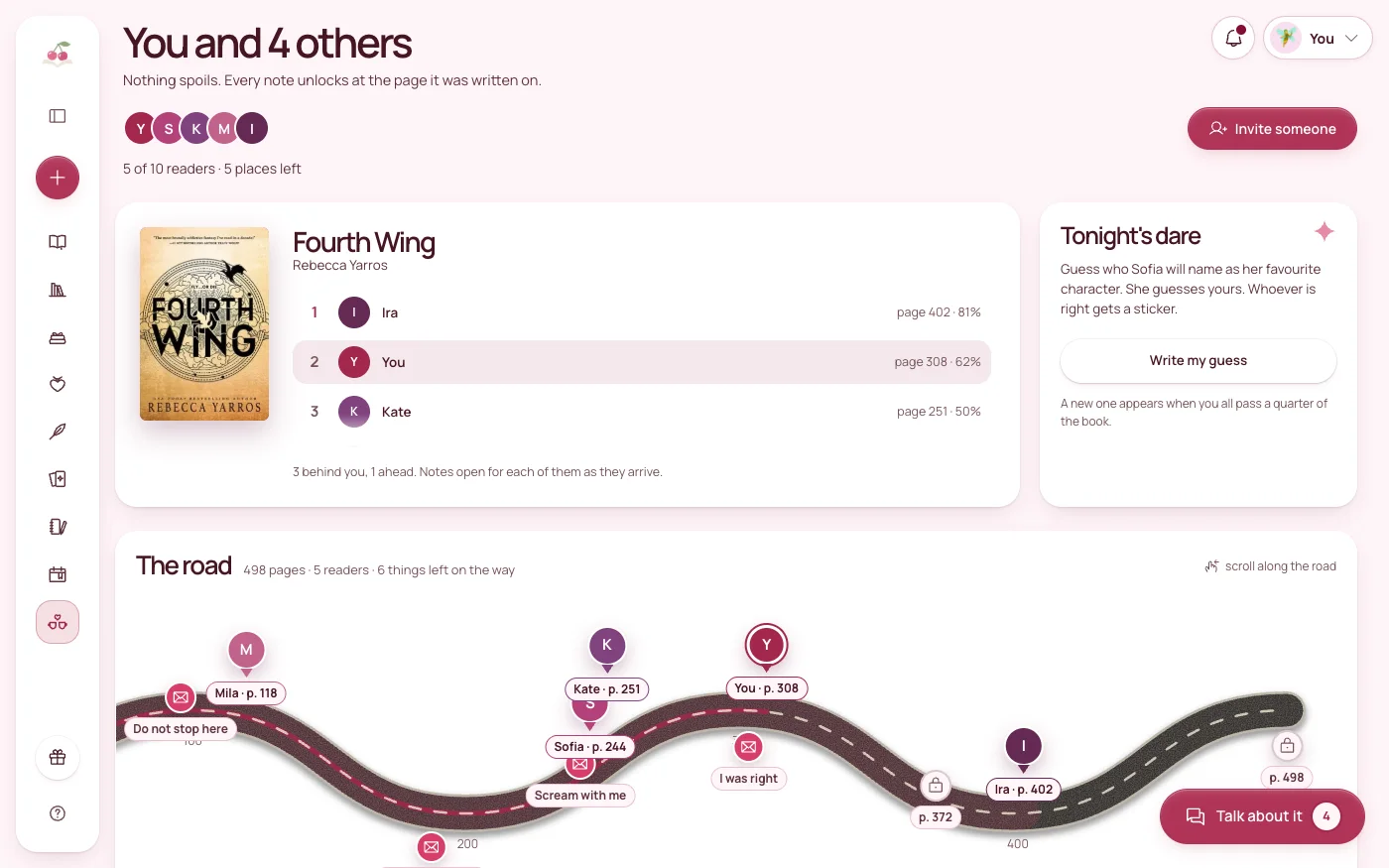
How to Run a Buddy Read Without Spoilers
How to buddy read romance without spoilers: pick the book, set milestones that survive different editions, seal your notes and handle the fast reader.
How to Track Tropes in the Romance Books You Read (and Use Them to Find Your Next One)
Tag two to four tropes on every romance you read, pick which ones to keep, and filter your shelf by trope to find your next book.